The Bread of the Tuscan Grape Harvest
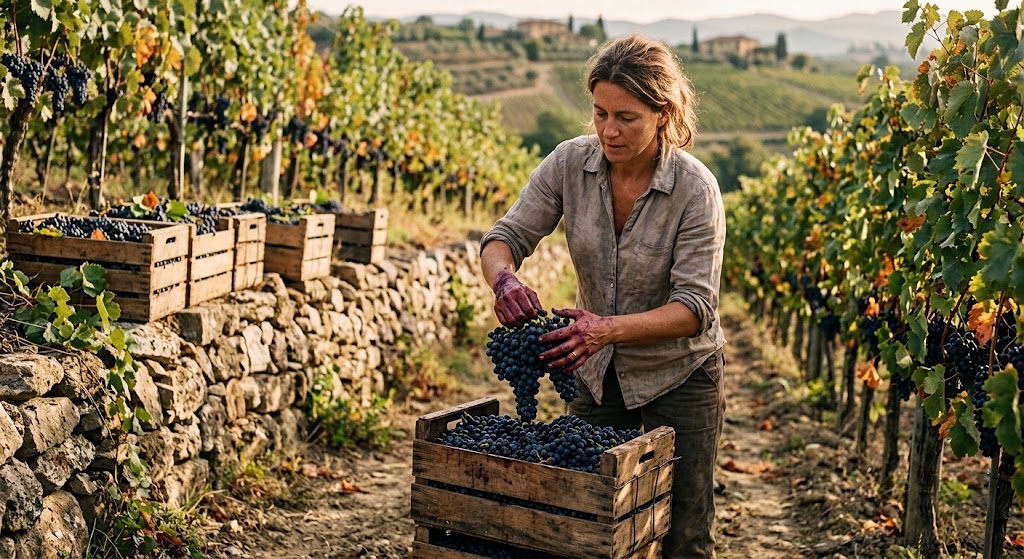
My neighbor Vittorio knows the day before I do. He has known it every year of his life, the way some people know a storm in their knees, and he stands at the end of the row with his hand on a bunch and says nothing at all for a long moment. Then he nods once. That nod is the whole announcement. By the following morning there are crates stacked against the stone wall and someone has already brought the small radio out and set it on an overturned bucket, and the Tuscan grape harvest has begun without anyone declaring it.
I have been here through five of these now and I still cannot get used to how ordinary it looks. In the photographs it is all baskets and light. In life it is backache and wasps and the particular indignity of grape juice drying inside your sleeve. It is also, and I want to be honest about this because I spent years cooking in rooms where honesty was not the point, the only week of the year when I remember why I left the restaurant.
What the Tuscan grape harvest actually smells like
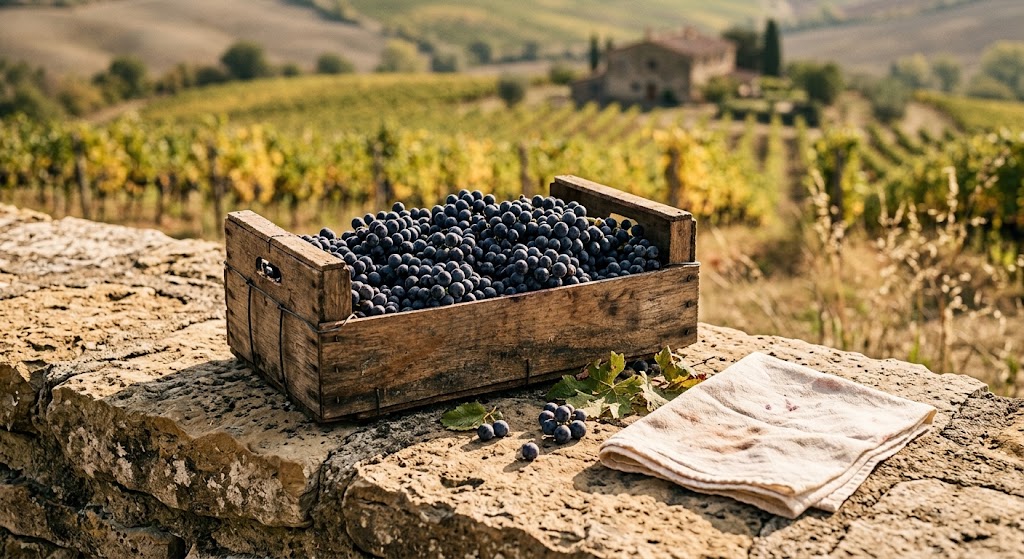
Not wine. That surprised me the first year. It smells like warm dust and crushed leaf and something faintly sour underneath, the beginning of fermentation happening in the bottom of a crate before anyone has decided it should. There is a sweetness on top of it that gets into your hair. For about ten days the whole valley carries it, and then one morning it is gone and the light has changed and it is autumn.
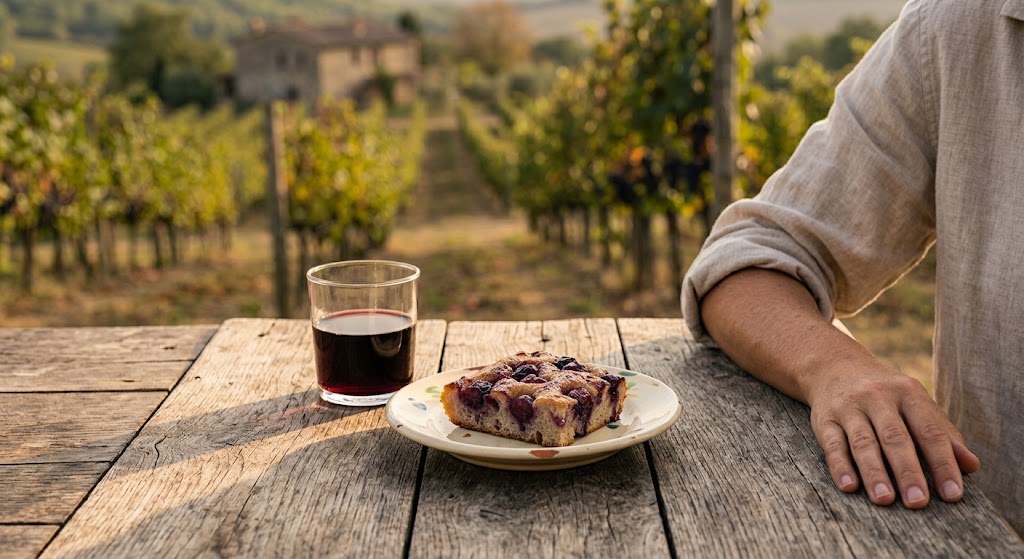
Somewhere in the middle of that week, someone always makes schiacciata con l’uva. Nobody plans it. It happens because there are too many grapes and not enough hands and the bread is the answer to both problems at once. You take the grapes that will not make it into the vats, the ones that got bruised in the crate or came off the stem too early, and you press them into bread dough with sugar and olive oil and you bake it flat and dark and sticky.
The first time I ate it I was standing up, holding it on a square of paper, and I burned the roof of my mouth and did not care. It tasted like the inside of a grape rather than like a dessert. That distinction has stayed with me.
Why it has to be wine grapes
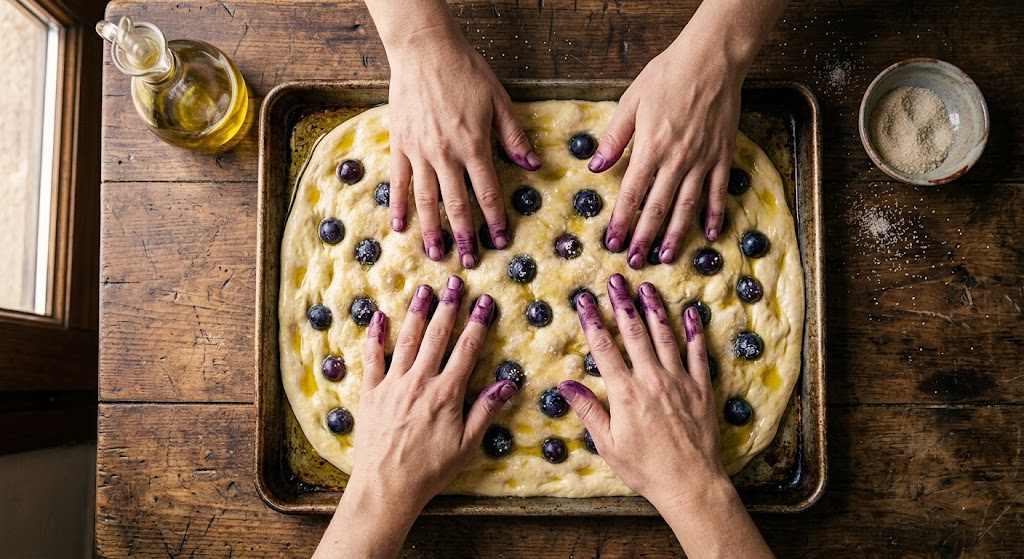
This is the part where I have to disappoint you slightly. The real thing is made with Sangiovese or Canaiolo, small wine grapes with thick skins and seeds still in them, and the seeds are not a mistake. They crack a little under your teeth. They give the whole thing a faint bitterness that keeps it from tipping into jam.
Every year some visitor asks whether they can use the big seedless table grapes from the supermarket and every year I say yes, of course, please make it. But I also tell them the truth, which is that it will be sweeter and softer and it will taste like a very good grape focaccia rather than like this specific thing. If you can find Concord grapes where you live, use those. They are not Tuscan and Vittorio would raise an eyebrow, but the skin-forward, slightly musky flavor gets you closer than anything else I have tried.
The lesson I keep relearning about not fussing
I trained in kitchens where a plate went back if the sauce sat two millimeters off center. I was good at that. I was also, by the end, so tightly wound that I could not eat my own food without auditing it.
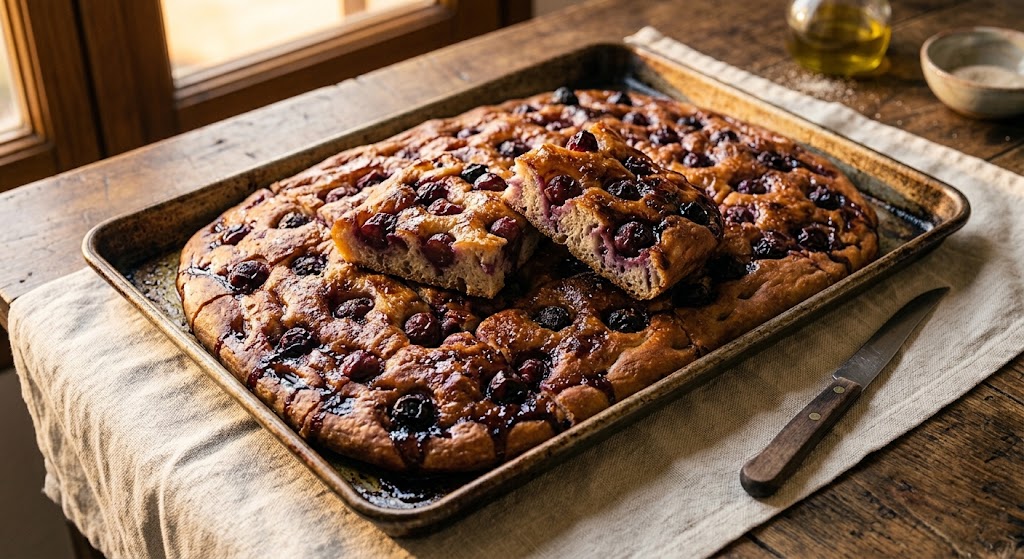
Schiacciata does not permit fussing. The dough is slack and unglamorous and refuses to be handled with any precision. The grapes go on in a rough single layer and some of them sit on top of each other and that is fine. It bakes unevenly on purpose, dark and caramelized at the edges where the juice ran out and pooled against the pan, softer in the middle. If you try to make it neat you will make it worse.
I think about that more than I expected to. There is a whole category of good things that only exist because someone was too busy to be careful.
Making it far from the vines
You do not need a vineyard. You need small dark grapes, a sheet pan, and the willingness to use more olive oil than feels correct. Do not reduce the oil. It is what makes the bottom crust go crisp and slightly fried under all that wet fruit, and without it you get something soggy and sad.
Two other things. Let the dough rest after you have topped it, even though it looks finished and you want to bake it. Fifteen minutes is enough and it changes the texture completely. And take it out when the edges look almost too dark. That is not burning, that is sugar, and it is the best part.
Vittorio ate a piece last year standing in the same spot he always stands, looked at the row he had just finished, and said it was a good year. He says that every year. I have decided this is not a lack of imagination. I have decided it is a man who has worked out how to be satisfied, which took me thirty-nine years and a career change to even attempt.
Make it while the grapes are still cheap and heavy. That window is short.
Schiacciata con l’Uva
Ingredients
Equipment
Method
- Whisk the flour, yeast, sugar and salt together in a large bowl. Pour in the warm water and 60 ml of olive oil and bring it together with your hands until there is no dry flour left. The dough will be slack and sticky. That is correct.
- Knead in the bowl for about 5 minutes, folding the dough over itself rather than working it on a counter. Cover and leave in a warm spot for 90 minutes, until roughly doubled.
- While it rises, pull the grapes off their stems, rinse them and dry them well on a towel. Wet grapes will steam the crust. Do not remove the seeds.
- Oil a 33 x 23 cm sheet pan generously. Divide the dough into two pieces, one slightly larger. Press the larger piece into the pan with oiled fingers, stretching it to the corners. Let it relax for a few minutes if it fights you.
- Scatter two thirds of the grapes over the base. Sprinkle with 50 g of the sugar and half the rosemary if using. Stretch the second piece of dough over the top and pinch the edges roughly to seal.
- Press the remaining grapes into the top layer so they sit half buried. Drizzle with 2 tbsp olive oil, scatter the last 30 g of sugar, the rest of the rosemary and a small pinch of flaky salt.
- Rest, uncovered, for 15 minutes. This step looks skippable and is not.
- Bake at 200 C (400 F) for 35 to 40 minutes, until the edges are deeply caramelized and the juice has pooled and darkened against the pan. It should look almost too dark at the corners.
- Cool in the pan for 20 minutes, then slide onto a rack. Eat warm or at room temperature, cut into squares, standing up if the moment calls for it.
Notes
- The seeds are traditional and add a faint bitterness that keeps the bread from tasting like jam. Leave them in if you can tolerate them.
- Seedless black grapes work and produce a sweeter, softer result closer to a grape focaccia.
- Do not reduce the olive oil. It is what crisps the underside beneath all that wet fruit.
- Best on the day it is baked. Day two is still good if you warm it for five minutes in a hot oven.
- Rosemary is optional and slightly modern. Vittorio does not use it.
Pairing Wine
A young, bright Sangiovese served slightly cool, which echoes the grape without competing with the sugar. For an evening version, a small glass of Vin Santo. Non-alcoholic: cold Concord grape juice cut half and half with sparkling water and a strip of lemon peel.